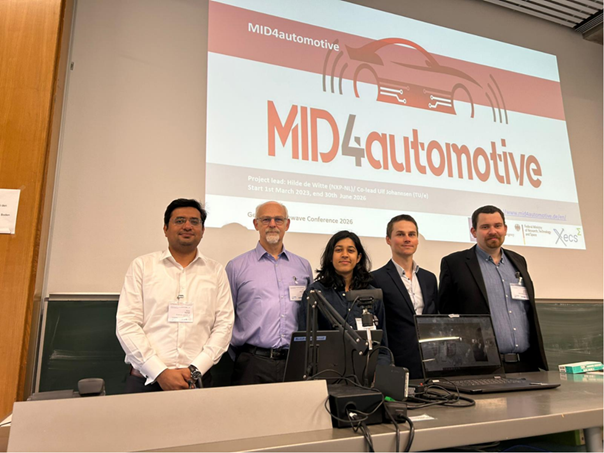
At the 17th German Microwave Conference (GeMiC), hosted by the Karlsruhe Institute of Technology (KIT) from March 9–11, 2026, in cooperation with IMA e.V. and VDE/ITG, the public workshop MID Technology for Automotive Applications took place as part of the official conference program. The workshop formed an important platform for presenting current research activities and technological developments in the field of Molded Interconnect Devices (MID) and their relevance for modern automotive systems.
The workshop featured a series of technical presentations that highlighted both fundamental research and application‑oriented innovations. The program included the following contributions:
- MID Lacquer for HF Applications
An overview of novel lacquer‑based MID structures optimized for high‑frequency signal performance.
- Design and Fabrication of a Low Noise Amplifier for Low‑Frequency Receivers Using 3D‑Printed Additive Manufacturing Technology
A demonstration of how additive manufacturing enables new design freedoms for RF components.
- Synchronization of Automotive Radars Using White Rabbit PTP
Insights into precise timing and synchronization concepts for next‑generation radar networks.
- A 77 GHz Photonic Radar Transceiver Chipset in 250 nm SiGe BiCMOS
A presentation on cutting‑edge photonic radar integration and chipset development.
- On‑Bumper Integrated 77 GHz Automotive Radar Antenna Using 3D MID Lacquer
A practical example of how MID technology enables seamless sensor integration into vehicle exteriors.
- MID Technology for Ethernet Receivers
A look at how MID‑based structures can support high‑speed data communication in space observation environments.
The speakers, representing research institutions and industrial partners from Germany and the Netherlands, presented the latest results from the ongoing collaborative project MID4Automotive. Their contributions illustrated the growing importance of MID technology for future automotive electronics, particularly in the context of radar sensing, high‑frequency communication, and integrated packaging solutions.
Approximately 25 participants attended the workshop, creating an engaged and interactive atmosphere. The audience included researchers, engineers, and industry representatives who used the opportunity to discuss technological challenges, potential applications, and future research directions. The workshop thus served not only as a platform for knowledge exchange but also as a catalyst for new collaborations within the MID and automotive technology communities.